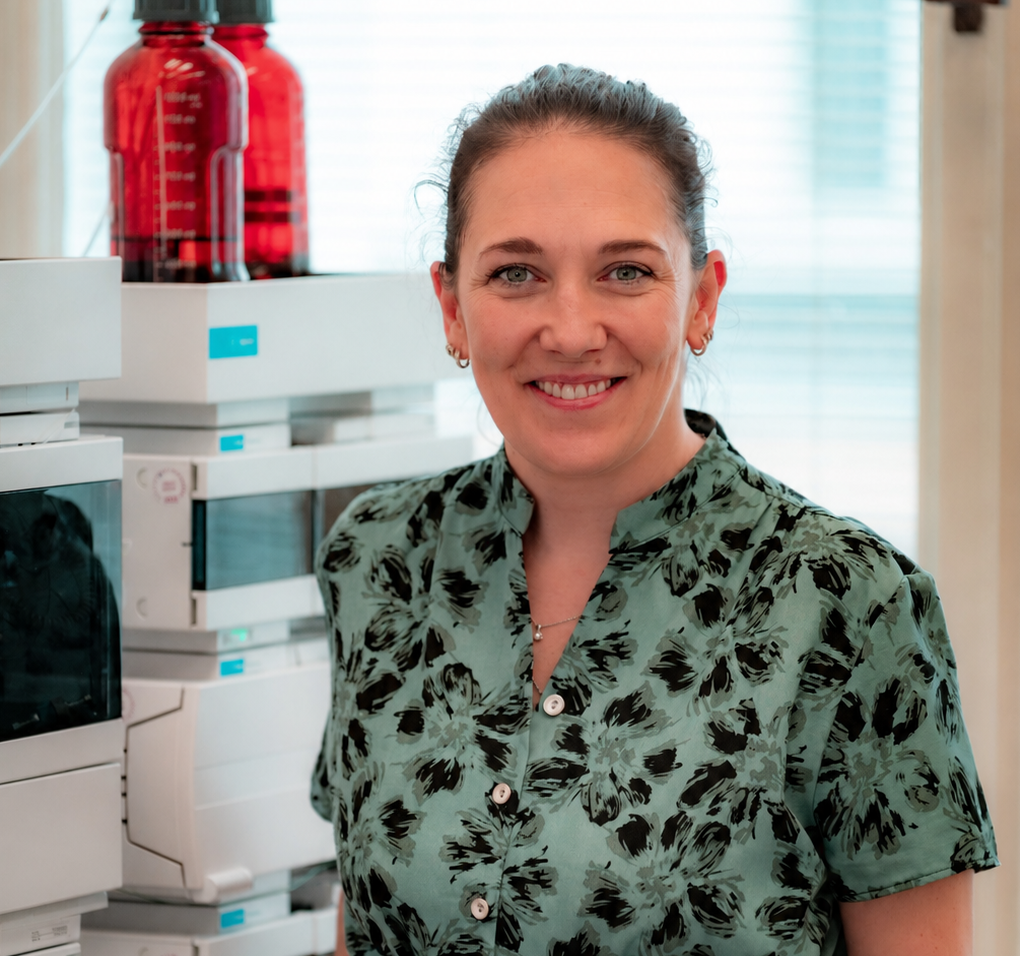
She completed her Master’s degree in Chemistry and Technology of Environmental Protection at the Faculty of Environmental Technology, University of Chemistry and Technology Prague, in 2009, where she also defended her doctoral dissertation in 2014. She has been affiliated with the Department of Environmental Chemistry since 2013, first as a research scientist and, from 2015, as an assistant professor. From September 2022 to February 2023, she was a Fulbright Visiting Scholar at the University of California, Berkeley, hosted by Prof. David L. Sedlak. Since 2024, she has served as Head of the Department of Environmental Chemistry, and as of 1 June 2026 she was appointed Associate Professor in Chemistry and Technology of Environmental Protection.
Her research focuses on environmental chemistry, particularly the fate, transformation and removal of hazardous organic contaminants from aqueous and subsurface environments. She has long worked on remediation technologies based on chemical reduction and oxidation, especially the use of nanoscale zero-valent iron and peroxydisulfate-based advanced oxidation processes in in situ chemical oxidation. In recent years, she has focused intensively on the degradation of benzophenone-type organic UV filters, the identification and assessment of their transformation products, and the broader issue of emerging environmental contaminants. Her work also includes the integration of chemical and biological remediation approaches and the evaluation of the influence of environmental matrices on the efficiency of decontamination processes.
Ongoing Research Projects:
- GA26-23628S: Mechanistic and Optimization Studies of Antiviral Drug Degradation in Water via Unactivated, Thermal, and Halide-Mediated Advanced Oxidation Processes
Recent Publications (Last 5 Years):
- Těšínská, P., Škarohlíd, R., Loos, A., Němcová, N., Šturmová, R., Navrátilová, M., Činčura, M., Kostrakiewicz, R., Michalcová, A., McGachy, L. (2026). Fe(II)/CA versus S-nZVI for peroxydisulfate activation: A comparative study on the removal of benzophenone-1 from water matrices. Emerging Contaminants, 100651. DOI: 10.1016/j.emcon.2026.100651.
- McGachy L., Škarohlíd R., Těšínská P., Loos A., Melliti A., Mocová K. A., Kulda T., Navrátilová M., Vazdar M., Vazdar K., Kosina J., Tarábek J.
Elucidation of pH-Dependent Pathways for Benzophenone 1 Transformation by Heat-Activated Peroxydisulfate: A Combined Mechanistic and Environmental Assessment.
ACS ES&T Water, 2026, 6, 365–376.
https://doi.org/10.1021/acsestwater.5c01079
- Kroužek J., Rippelová V., McGachy L., Škarohlíd R., Hendrych J., Mašín P.
Microwave-enhanced catalytic oxidation of VOCs: from lab-scale optimization to pilot-scale industrial application.
Results in Engineering, 2025, 108096. 10.1016/j.rineng.2025.108096.
- Desmarais M., Fraraccio S., Ridl J., Suman J., Perez-Potti A., Dawson K. A., Dolinová I., McGachy L., Hradilová M., Sevcu A., Strejček M., Uhlík O.
Phenol-driven cometabolic degradation of cis-1,2-dichloroethene (cDCE): Insights from Acinetobacter pittii and Ectopseudomonas alcaliphila.
Environmental Sciences Europe, 2025, 37, 196.
https://doi.org/10.1186/s12302-025-01237-z
- Rippelová V., McGachy L.
Odhad sorpčního koeficientu na základě obsahu organického uhlíku a půdní textury.
Chemické listy, 2025, 119(09), 526–532.
- McGachy L., Škarohlíd R., Kostrakiewicz R., Kühnl K., Těšínská P., Müllerová B., Šír M., Martinec M.
Peroxydisulfate persistence in ISCO for groundwater remediation: Temperature dependence, batch/column comparison, and sulfate fate.
Water, 2024, 16(24). https://doi.org/10.3390/w16243552
- Rippelová V., McGachy L., Janků J., Kroužek J.
Estimating tetrachloroethene sorption coefficients based on soil properties in organic-poor soils. Applied Sciences, 2024, 14(24), 11761. https://doi.org/10.3390/app142411761
- Těšínská P., Škarohlíd R., Kroužek J., McGachy L.
Environmental fate of organic UV filters: Global occurrence, transformation, and mitigation via advanced oxidation processes.
Environmental Pollution, 2024, 363, 125134.
https://doi.org/10.1016/j.envpol.2024.125134
- Škarohlíd R., Kraljič D., Suchan J., Kühnl K., Hanzlová B., Těšínská P., Kholomyeva M., Martinec M., Michalcová A., McGachy L.
Overlooked Effects of Chlorides and Bicarbonates on the Intensity of Peroxydisulfate Activation in Fe(II)/citric acid-S₂O₈²⁻ Process.
Environmental Technology & Innovation, 2024, 35, 103687.
https://doi.org/10.1016/j.eti.2024.103687
- McGachy L., Kroužek J., Škarohlíd R.
Perzistentní organické látky PFAS: výzvy, dopady a legislativní opatření.
Chemické listy, 2024, 118(12), 639–644.
- McGachy L., Sedlak D. L.
From Theory to Practice: Leveraging Chemical Principles To Improve the Performance of Peroxydisulfate-Based In Situ Chemical Oxidation of Organic Contaminants.
Environmental Science & Technology, 2024, 58, 17–32.
https://doi.org/10.1021/acs.est.3c07409
- Rošková Z., Škarohlíd R., McGachy L.
Siderophores: an alternative bioremediation strategy?
Science of the Total Environment, 2022, 819, 153144.
https://doi.org/10.1016/j.scitotenv.2022.153144
- McGachy L., Heyda J., Tomas J., Čejková J.
Decanol pattern formation over a sessile aqueous decanoate droplet.
Colloids and Surfaces A: Physicochemical and Engineering Aspects, 2021, 621, 126541.
- McGachy L., Škarohlíd R., Martinec M., Rošková Z., Šmrhová T., Strejček M., Uhlík O., Marek J.
Effect of chelated iron activated peroxydisulfate oxidation on perchloroethene-degrading microbial consortium.
Chemosphere, 2021, 266, 128928.
https://doi.org/10.1016/j.chemosphere.2020.128928